Thursday, November 16, 2006

Life After Princess Leia

Director George Lucas announced recently that he'll be quitting the blockbuster film biz and that the future lies in small films and Web distribution.

At a groundbreaking ceremony for his renamed alma mater, the School of Cinematic Art at University of Southern California, Lucas said spending $100 million on a making a film and another $100 million for marketing makes no sense.

"I think people are going to be drawn to a certain medium in their leisure time and they are going to do it because there is a desire to do it at that particular moment in time, " said Lucas. "Everything is going to be a matter of choice. I think that is going to be a huge revolution in the industry."

That being said, Indiana Jones 4 is still in development and intended to be released on the good old fashioned large screen. "We are not rushing in, we are trying to find out exactly where the monetization is coming from." Amen, brother.

Wednesday, November 15, 2006

High Art on YouTube

NYTimes today does a good job of mining the dark YouTube depths for high art gems...


Ferreting around cyberspace in YouTube can be a bit like going down the rabbit hole, entering a strange, oddly seductive media universe in which normal standards you’d bring to the consumption of culture don’t seem to apply. Why would anyone want to watch some nobodies from Grand Rapids performing “A Chorus Line”? You scoff, and then, possessed by curiosity, outrage or some other impulse, you click.


Sunday, November 12, 2006

Second Life


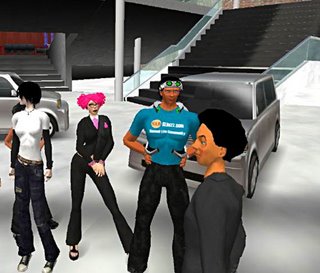
With the mid-term election over and a flurry of changes and posturing in its aftermath - I want to take a moment to look back at one of the most interesting new media moves by a politician during the entire election season. Former Virginia Governor Mark Warner participated in a simulated interview at Second Life -- a Web site that offers participants the chance to wander around in a simulated world and interact with one another.

Warner created an avatar -- a "virtual" representation of himself -- to appear in the interview.

He went as a tall white man dressed in a suit, not a far stretch from his typical off-line wear. A remarkable difference was that the virtual Warner flew onto the stage to make his remarks -- a feat the real world Warner has yet to pull off (as far as we know).

Asked why he chose to be the first virtual politician, Warner said, "How people communicate and what type of communities they form is changing in real time."

Warner had a career as a technology entreprenuer before he became Governor of Virginia.


Second Life is a 3D online world with a rapidly growing population of over a million residents from 100 countries around the globe. The residents themselves create and build the world. Second Life is created by Linden Lab, a San Francisco-based company founded in 1999 by Philip Rosedale to "create a revolutionary new form of shared 3D experience." The former CTO of RealNetworks, Rosedale pioneered the development of many of today's streaming media technologies, including RealVideo.


Second Life has been on the cover of Business Week, on the front page of the New York Times Escapes section and in the coverage of Reuters, which has now assigned a reporter to operate full-time inside Second Life.


http://lindenlab.com/news

Basic memberships for Second Life are free. Reporters can create a free account online at https://secondlife.com/join/. To enter into the world, download the necessary software at https://secondlife.com/community/downloads.php.

I just joined Second Life where I can own land, start my own business and trade in commerce with currency known as Linden dollars. My name there? Madeline Lightfoot -as of now my avatar is an urban black male. (All of the women pre-fab Avatars look like low-life Barbies).

I will keep you updated on my new, Second Life.

CNN talks about more than 60 universities setting up a presence on Second Life http://www.cnn.com/2006/TECH/11/13/second.life.university/index.html


Business Week talks about CEO's hanging out on Second Life http://www.businessweek.com/magazine/content/06_47/b4010068.htm

News from Second Life http://nwn.blogs.com

Friday, November 10, 2006

Chicks n' Flicks

Some like-minded persons from the West Coast:


http://www.womedia.org

Based in San Francisco, Women's Educational Media (WEM) is a highly acclaimed progressive social issue documentary film production company and a leader in the field of anti-bias education. WEM's primary current focus is its Respect for All Project, a series of highly successful campaigns designed to address issues of prejudice among young people and the adults who guide their development.

Through the distribution of award-winning films, accompanying curricula, and a training program aimed at educators, youth service providers and parents, the project strives to create safe schools and communities by opening up dialogue about diversity and discrimination.

Tuesday, October 31, 2006

Welcome to the Revolution


Grrrrrrrreat New York Times article today about the purchasing power of women. Stunning statistics and comprehensive coverage of the feminine world of financial acumen.

The reporter buried the most stunning statistic of all (which I heard before, but forgot because it was... well - so STUNNING): According to the National Association of Realtors single women are the fastest growing segment of home buyers purchasing 21 percent of homes, compared with just 9 percent for single men.

Market researchers are now embracing women as much more than domestic divas. They recognize them as buyers with their own careers and fattened pocketbooks, who are finding plenty to do and plenty to buy outside the home.

The article is chock full of other great statistics; the Canadian developer Shane Homes states that women control 80 percent of every consumer dollar spent. They call that the 80 Percent Minority.

Also interesting websites to check out:

www.bostongalsopenwallet.blogspot.com - tracks "Jane Dough's" finances and her financial decision making every month "because speaking publicly about your personal finances was a no-no in my family" says Dough. She feels by blogging about it - she can find enlightenment in managing her $461,435.59 (in October) of assets.

Of course there is BeJane.com the early bird on-line community for women into home improvement.

More companies, in the United States and elsewhere, have realized that they overlook women at their own financial peril. The companies are realigning their marketing and design practices, learning to court an increasingly female-centric consumer base that boasts more financial muscle and purchasing independence than ever before.

“We are perhaps on the first step to a matriarchal society; women will earn more money than men if current trends continue by 2028,” said Michael J. Silverstein of the Boston Consulting Group. “The trend has been escalating in the last 10 years as there has been a gradual, slow erosion of the power balance in the family, a psychic rebalancing.”

Women, Mr. Silverstein added, are “controlling purchases and driving a shift in our economy.”

http://www.nytimes.com/2006/10/29/business/yourmoney/29women.html?pagewanted=1&ei=5087%0A&em&en=45d6f45322e53acc&ex=1162443600&adxnnl=0&adxnnlx=1162335757-KM9CW2FtPeiQDWRw4i2lfA

More Reasons to Love Chicago

Colombia College of Chicago's Frequency TV recently became the first college television station to offer entertainment programming as Podcasts through the iTunes Music Store, says the online edition of the Colombia Chronicle.

http://www.columbiachronicle.com/paper/campus.php?id=1895


Their original sketch comedy program called Out on a Limb has been streaming to more than 1,1oo subscribers from all over the world since October 28th, with 100 t0 200 new subscribers each day. As of Nov. 10, six more shows become available for download. It's free to download - which still begs my nagging, nagging banal question - how do we make money in this new era?! Gosh.

Frequency TV programming can be found on iTunes by searching for ?artist Frequency TV.?

Sunday, October 29, 2006

The Devil and Daniel Johnston

Daniel Johnston is a manic-depressive genius singer/songwriter/artist, revealed in this portrait of madness, creativity and love.The Devil and Daniel Johnston is a stunning portrait of a musical and artistic genius who nearly slipped away.

Director Jeff Feuerzeig exquisitely depicts a perfect example of brilliance and madness going hand in hand with subject Daniel Johnston. As an artist suffering from manic depression with delusions of grandeur, Daniel Johnston's wild fluctuations, numerous downward spirals, and periodic respites are exposed in this deeply moving documentary.

http://www.sonyclassics.com/devilanddaniel/aboutthefilm.html


http://www.austinchronicle.com/issues/vol18/issue51/music.johnston.html

Saturday, October 14, 2006

Proving the Impossible


"He proved the impossible: that the poor were bankable."JONATHAN J. MORDUCH, an economics professor at New York University, on Muhammad Yunus, who won the Nobel Peace Prize for pioneering work in giving tiny loans to millions of poor people.

Encouraging news that the 66-year-old Bangladeshi economist Muhammad Yunus won the Nobel Peace Prize yesterday for his pioneering work in giving small, even tiny loans to millions of poor people no bank would touch. By empowering destitute widows, abandoned wives, landless laborers and rickshaw drivers, sweepers and beggers, Yunus has made great strides in combating rural poverty in his own country and inspiring similar programs across the developing world.

“Microcredit has proved to be an important liberating force in societies where women in particular have to struggle against repressive social and economic conditions,” the committee said in announcing the prize.

Mr. Yunus has long been an influential champion of the idea that even the most impoverished people have the drive and creativity to build small businesses with loans as small as $12, and Grameen Bank has dedicated itself to helping the poorest of the poor.

Go Mr. Yunus.

http://www.nytimes.com/2006/10/14/world/asia/14nobel.html?_r=1&th&emc=th&oref=slogin

Thursday, October 12, 2006

Wit, Will and Walls in Loudon Times-Mirror

Speaking your mind
By Betsy Allen
10/11/2006

Put yourself in Betty Kilby Fisher's place: a teenager living in Virginia 50 years ago -- trying to do well in school, make friends, fit in.

Now, imagine you are thrown into a situation where your mere presence drives students from the school's doors. Picture yourself as a source of turmoil and target for some of the worst kinds of ugliness human beings can conjure.

Could you endure?Tanesia Fisher, 16, a junior at Stone Bridge High School, doesn't think so."I probably wouldn't have been as strong as her. I couldn't have handled it."

Tanesia is the granddaughter of Betty Kilby Fisher. And this was the situation Fisher found herself in during the late 1950s, when she was a 13-year-old living in Warren County.Dismayed by widespread segregation practices, Betty's father, James Kilby, decided to draw the line with his own daughter.

He filed a case in Betty's name to force the integration of Warren County High School. Ordered by federal courts to end segregation, Virginia balked; instead, the governor ordered the closing of that school, along with others in the state, as part of a policy of Massive Resistance.

Eventually, Virginia's Supreme Court ruled that policy unconstitutional and the schools reopened, but the white students stayed away. For months, Betty and a handful of other black teenagers walked the quiet halls at Warren County High School.Over time, white students returned - some with a vengeance. Betty was emotionally, verbally and physically abused, and resulting trauma has stayed with her throughout her life.

People may not "understand the price that we paid to get an education," said Betty, 61, who now lives in Euless, Texas.

"That's the way you take someone's power away," said Paulette Moore, a documentary film director associated with Shenandoah University in Winchester. Moore is producing a film about Betty and the events of 50 years ago.

"[Betty] didn't tell anyone what happened," said Moore. "If young girls told their families, they would have to go and defend their honor. People could get killed."

In 2002, Betty shared her experiences in a book, "Wit, Will and Walls.""When I first wrote my book, I had an image of young people reading the book," said Betty. "There were things I didn't want to put in. But if I cut and pasted pieces, it wouldn't be a real story. I thought, if I am going to touch people, it will be with the raw truth."


Moore found Betty's story deeply compelling, and an ideal subject for a documentary film. When it came to casting the film, Betty felt strongly that her granddaughter Tanesia could play an important role - that of Betty herself.

Tanesia is thoughtful and direct when asked about her grandmother's experiences and her decision to be part of the film.

"I've always been really close to my grandmother. I knew some of the story," said Tanesia. "But I didn't know all the stuff she had to go through. When I read the book, I was surprised. I was kind of hesitant about the whole acting thing ... showing so much emotion, but I didn't want to disappoint my grandmother. It means a lot to her."

A four-day shoot in mid-August took the film production crew and cast to locations around Clarke and Warren counties to re-enact key events in the story. Moore now is seeking additional funding to undertake a second phase of the documentary production. She has a target completion date of 2008, 50 years after the original case was filed.

The director is constructing the historically based film in a way that young people today can relate to, with limited black-and-white footage - "the events took place in vivid color" - and contemporary music instead of gospel or march songs.

She feels there is an important message here.

"You don't have to be Betty Kilby Fisher to make a change. It's not alchemy," said Moore. "It starts with just speaking your mind."

That's something Tanesia does well. She realizes there are people who honor the legacy of her grandmother - and those who don't.

"You can't force people to appreciate it," said Tanesia. "No one changes just because of one decision someone makes. Racism is still everywhere. It's still in school. Most people are in denial." But she adds, "If you reach out to the younger kids, they'll realize that what they have now is something to be grateful for."

What Tanesia has now are some specific goals. She wants to go to college, earn a business degree and open a seaside resort hotel in her mother's native country, the Philippines.A grand dream, perhaps, for any high schooler - but one that seems in reach. And for that we can thank, in large part, people like Betty Kilby Fisher, who gained their own beachheads in Virginia's civil rights movement half a century ago.

Friday, September 29, 2006

What the Bleep?!

It only took me two years to view the mind-bending film What the Bleep Do We Know? which combines the laws quantum physics with spirituality. Watching it last night was very timely - just the day before I had a conversation with young Winchester filmmaker Kevin Matheson about how his thoughtful film about his addictive brother may have brought about a long term change in his brother's behavior.

What the Bleep? explains that electrons can behave either as particles or as waves - and it depends on whether they are being observed or not. The Bleep filmmakers contend that being that we are made up of electrons, our mere observation in our life, and the way we observe it can change our reality - much like those crazy electrons. Whoa. I love it. Especially being a filmmaker who observes for a living. And I think so many other people love it because it feels inherently true.

The film gets a bit kum bah ya at the end - a little too much triumph of the human spirit for my snarky liking, but overall, it is great brain yoga.

It's part documentary/part drama with Marley Matlin as a cranky photographer having an existential experience.

http://www.whatthebleep.com

Critics hate the film BTW. Which has made it a marketing phenomenon. Quantum Physicist Mr. Porteno is suspicious but not completely damning.

Saturday, September 23, 2006

Inanimate Hostility

This from my friend Dr. Deborah Lee - finally! A scientific explanation for why your computer crashes and all of your memory disappears from your hard drives only when you are careening toward deadline with no room for error.

Resistentialism (ri-zis-TEN-shul-iz-um) noun The theory that inanimate objects demonstrate hostile behavior against us.[Coined by humorist Paul Jennings as a blend of the Latin res (thing)+ French resister (to resist) + existentialism (a kind of philosophy).]If you ever get a feeling that the photocopy machine can sense when you'retense, short of time, need a document copied before an important meeting,and right then it decides to take a break, you're not alone. Now you know the word for it.

Here's a report of scientific experiments confirming the validity of this theory:https://mail.su.edu/exchweb/bin/redir.asp?URL=http://www.uefap.co.uk/writing/exercise/report/clatri.htm

Saturday, September 16, 2006

What a Woman!

We lost a truly grand person this week with the death of 73-year-old saucy/smart former Texas governor Ann Richards. As a young reporter, I watched her, awestruck, from the floor of the 1988 Democratic Convention in Atlanta as she delivered a rousing speech with a few of her famous salvos, one for pappy George Bush:

"Poor George, he can't help it. He was born with a silver foot in his mouth!"

And in keeping with her dedication to push for the rights of all minorities - this good perspective on the talents of women:

"Ginger Rogers did the same thing that Fred Astaire did... she just did it backwards and in high heels!"

Here is the NYTimes obit:

http://www.nytimes.com/2006/09/14/us/15richardscnd.html?ex=1159070400&en=b97d44acd85fdace&ei=5070&emc=eta1

And more hilarious quotes from the guv:

(On ineffective government programs) "You can put lipstick and earrings on a hog and call it Monique, but it's still a pig.''

"A woman's place is in the dome."

"I've always said that in politics, your enemies can't hurt you, but your friends will kill you."

Asked once what she might have done differently had she known she was going to be a one-term governor, Richards grinned. "Oh, I would probably have raised more hell."

"Let me tell you that I am the only child of a very rough-talking father. So don't be embarrassed about your language. I've either heard it or I can top it."

"I get a lot of cracks about my hair, mostly from men who don't have any."

Freakonomics

This best-selling book was a little ADD for me to connect all the dots drawn by authors Steven Levitt and Stephen Dubner - but their curious and chaotic take on the world is exactly what makes their blog so much fun... engaging bits about everything everyday. http://www.freakonomics.com/blog/

Friday, September 08, 2006

Radical Redfin

It's about time! Who knew talk of real estate could be interesting and even radical? A new real estate service called Redfin buys and sells homes online and has a really entertaining blog.

http://blog.redfin.com/blog/redfin/?rt=fn-bl

The NYTimes had a great article on the group last week.

support@redfin.com

Excellent that Redfin is doing away with the 6 percent fee that goes to real estate agents who basically offer the service of multiple listing and are doing that with attitude and optimism. Too bad they are only in CA and Washington State right now. Really though, what took so long?!

Thursday, September 07, 2006

EnterTech...

...an unfortunate name for an interesting film program at Arizona State University. Their film school is just a year old, but the principals are listening to the universe and trying in the rapidly changing environment to figure out how to prepare the futures of the film industry to be fluent in the language of technology AND content. Impressive that an advisory board of two dozen film veterans - mainly producers, lawyers and studio executives - has signed on to help shape the curriculum and speak to students about the challengs facing the entertainment industry.


"We know that the dominance of 35-millemeter film is over," says Peter Lehman, the director of film and media studies program. "We are in a period of massive change and uncertainty. We need a new kind of person in this industry."


http://www.nytimes.com/2006/09/06/movies/06tech.html?ex=1157774400&en=bd94c5820b804ee5&ei=5087%0A

The Magic Millenium

Celebrating Chicago this week - here in the windy city on family biz and had not seen the marvelous Millenium Park opened in 2004. It gives me great hope that a city has focused so grandly and eloquently on its public spaces. The serpentine walkway from the shores of Lake Michigan to the mind-boggling Frank Gehry bandshell is the entree to acres of sparkling experience - the Crown Fountain, the Cloud Gate, the Lurie Gardens, The Art Institute and beyond.


http://www.millenniumpark.org/

Where I feel New York remains stunned and San Francisco a bit torn between its bohemian and dot-com histories - Chicago feels fresh and free, an American city that knows what it has, and knows how to use it.

http://en.wikipedia.org/wiki/Millennium_Park

Friday, September 01, 2006

Secrets and Lives

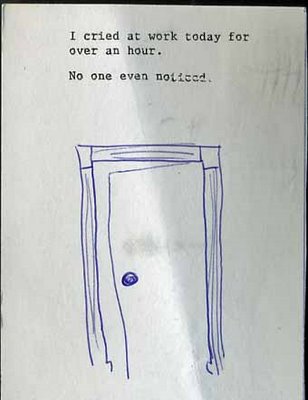
I am fascinated with a project out of Germantown, MD. where people write their deepest secrets on postcards and send them anonymously to artist Frank Warren.

It started out as Warren's temporary community art project. Now it's where thousands go to post their secrets, and where millions go to read them. Secret-tellers send their secrets to his home here in suburban Washington, D.C., on postcards they decorate themselves. Warren reads every one and picks 10 to 20 to post on his blog every Sunday.

http://www.postsecretblogspot.com/

They are mini-works of art. Some are heartbreaking, some are hilarious, some are touching or thought-provoking or shocking or silly or repulsive.

Among the most shocking posts was one featured in the Washington Post last year - the secret that the confessor's family thought he/she was dead after 9-11.

Coming up in October, a presentation by Frank Warren, Thursday, Oct. 5, 6 p.m., at George Mason's Fall for the Book Festival at the campus' Concert Hall, Center for the Arts.

http://www.fallforthebook.org/postsecret.html


http://www.usatoday.com/tech/news/2006-03-14-postsecrets_x.htm?POE=TECISVA

Monday, August 28, 2006

Cool Russian

I don't know where this animation of an artist sketch comes from exactly... but it is beautiful. Enjoy.

http://fcmx.net/vec/v.php?i=003702

Thank you, Mr. Porteno.

Monday, August 21, 2006

Wit, Will and Walls

Some updates this month on my ongoing documentary Wit, Will and Walls: The Betty Kilby Fisher Story. The documentary tells the story of one woman's fight along with her family for desegregation in the Shenandoah Valley.

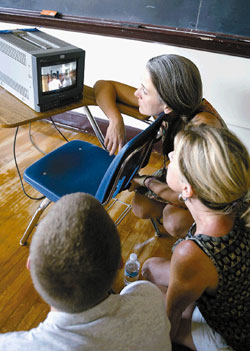
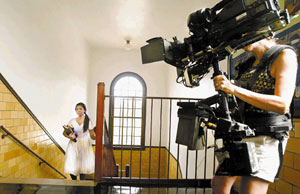
On August 9th my favorite TV team (which includes Director of Photography Sheila Smith and Lighting Director Claiborne Lashley) assembled to shoot recreations for the first phase of the show which we are calling "the promo". The promo, funded by the Virginia Foundation for the Humanities, includes interviews from a public forum of scholars last April and the latest recrees and is intended to convey the style and content of a greater documentary to potential funders.

This piece will be finished by the end of September and I begin right now to search for the REST of the cash to complete the hour long documentary on the topic.

Betty Kilby Fisher's granddaughter Tanesia played Betty with grace and skill on location at Warren County High School - the school that Betty attended in the 1950s and helped integrate.

We received some good press in these dog daze of summer - check out some of the local newspaper sites:

(you need to sign in for a free subscription - but it is easy)

http://www.winchesterstar.com/TheWinchesterStar/060816/Default.asp


Thursday, August 10, 2006

Try to Keep Up

Some good content and context today - I received a call to enter a Current TV short film contest on tolerance. Don't know how I missed the year-ago launch of this Al Gore inspired network, but that is the way it is these days - isn't it? Yikes. Just try to keep up.

This post is long - but I found the content of especially the NYTimes article so compelling that I thought I should put it up front. And I will try to include some entertaining, if not relevant pictures to keep an interest.

This excerpted from a June 4 LA Times article:

http://www.current.tv/news/latimes060406

Current TV is a year-old California-based cable channel created by Al Gore and Joel Hyatt to encourage every citizen to become both television viewer and programming contributor. As might be expected, some pieces take shots at the political right, such as an animated parody of President Bush. But others, such as a pair of pods on immigration, try for balance and describe both sides of an issue. Viewers can also contribute commercial advertisements.

Current also offers tutorials in filmmaking, journalism and storytelling from veterans including Sean Penn, Ira Glass, Dave Eggers and Catherine Hardwicke on its website (www.current.tv).

Current's main operations are headquartered in San Francisco, where teams of employees evaluate hundreds of submissions from around the world in dozens of categories.

The Internet and "American Idol" have become runaway successes because they offer people a chance to participate. "Now we're bringing that to TV, 24/7," says Current host Max Lugavere. Similarly, IFC will introduce a half-hour series, "Media Lab," in June to showcase short films by aspiring filmmakers. More than 1,000 short films have been submitted to the ongoing show. Like Current, the highlighted films will be determined by the public's online vote. MTV has had film contests and E! collaborated recently with the YouTube.com website in a video contest. Viewers also contribute a variety of videos to other sites, such as Google, Yahoo and iFilms, which was recently purchased by Viacom, owner of MTV.

The NYTimes gives perspective on how Current fits into current trends. Excerpts from that:

http://www.nytimes.com/2006/01/22/business/yourmoney/22youth.html?pagewanted=2&_r=1

http://www.current.tv/news/nytimes012206



The number of vehicles through which young people find entertainment and information (and one another) makes them a moving target for anyone hoping to capture their attention.
Advertisers and media and technology companies, mindful that young consumers have migrated away from the traditional carriers of their messages, have begun to find new ways to reach them. They are creating advertising and short videos for mobile phones, for instance, cell networks with dedicated game channels, and $1.99 TV programs to download to iPods and PC's.
And while the emerging generation's deftness with technology is a given, researchers say the most potent byproduct may be the feedback factor, which only accelerates the cycles of what's hot and what's over.


"We think that the single largest differentiator in this generation from previous generations is the social network that is people's lives, the part of it that technology enables," said Jack McKenzie, a senior vice president at Frank N. Magid Associates, a market research and consulting firm specializing in the news media and entertainment industries.
"What's hard to measure, and what we're trying to measure," Mr. McKenzie continued, "is the impact of groupthink, of group mentality, and the tendency of what we might call the democratization of social interaction and how that changes this generation's relationship with almost everything they come in contact with."

Karell Roxas, 24, a senior editor at Gurl.com, begins each day in her Williamsburg, Brooklyn, apartment with a diet of Gmail, Hotmail, work e-mail, NYTimes.com ("I haven't picked up a print newspaper in forever," she says) and blogs, in that order. She says it is a necessary regimen for maintaining a functional dialogue both at work and in her circle of friends.
Ms. Roxas, who grew up in Ontario, Calif., and earned a fine-arts degree in writing from the Pratt Institute in Brooklyn, says text messaging by cellphone is the default mode of communication for her set, surpassing e-mail, instant messaging or even talking on the phone itself.

It is all in keeping with recent research from the Pew Internet and American Life Project, which has found that while certain aspects of online life have become common across many age groups, it is the millennials who live at the digital edge.

Among those with access to the Internet, for instance, e-mail services are as likely to be used by teenagers (89 percent) as by retirees (90 percent), according to Pew researchers. Creating a blog is another matter. Roughly 40 percent of teenage and 20-something Internet users do so, but just 9 percent of 30-somethings. Nearly 80 percent of online teenagers and adults 28 and younger report regularly visiting blogs, compared with just 30 percent of adults 29 to 40. About 44 percent of that older group sends text messages by cellphone, compared with 60 percent of the younger group.

And as the millennials diverge from their elders in their media choices, so do the ways in which they can be reached and influenced.

The preceding generation may have thought that e-mail, newsgroups, Web forums and even online chats accelerated the word-of-mouth phenomenon. They did. But they are nothing compared with the always-live electronic dialogue among millions of teenagers and 20-somethings.

"What we're seeing is a whole different relationship with marketing and advertising which obviously has ripple effects through the entire economy," said Mr. McKenzie, who heads the Magid firm's Millennials Strategy Group, formed two years ago to serve clients desperate to know how to reach a new generation.

For the millennials, he said, "reliance and trust in nontraditional sources - meaning everyday people, their friends, their networks, the network they've created around them - has a much greater influence on their behaviors than traditional advertising."

Magid calls it the peer-to-group phenomenon - a digital-age manifestation of the grapevine.
"When someone wants to share it, forward it, record it, take a picture of it, whatever the case may be, that puts it into a form of currency," Mr. McKenzie said. "And when marketing gets to a level of currency, then it has achieved nirvana status."

And, he added, that status has "much more influence on the acceptance of television shows, or radio shows, or iPod offerings or jeans or whatever the case may be."

Some researchers, like Dr. Melvin D. Levine, director of the Clinical Center for the Study of Development and Learning at the University of North Carolina School of Medicine, have expressed concerns about the group-mentality dynamics that the Internet and the instant-message age may be fostering.

"You've got a group of kids who are unbelievably, incredibly loyal to each other," Dr. Levine said. "They are very bound to ethics and values. But in a funny sort of way, it prevents some of them from developing as individuals." Along with finding technological dexterity in this group, and a highly developed ability to work in team settings, Dr. Levine said he had encountered concerns that some young people lacked the ability to think and plan for the long term, that they withered without immediate feedback and that the machinery of groupthink had bred a generation flush with loyal comrades but potentially weak on leaders.

Ms. Roxas would wholeheartedly disagree. Working at Gurl.com, she says that it is all too common for older people to dismiss the "MTV generation" as lacking concentration and wherewithal, as being team-oriented but bereft of individual ideas, and as being hopelessly addicted to the hive.

The relentless multitasking and interactivity are "just a different way of doing things," Ms. Roxas said, recalling that even as an undergraduate she would often seek help and counsel among her peers through instant messages on her computer. "I actually got more done that way," she said, "and I always knew when to sign off and get my work done.
"It's no different than eating and watching TV at the same time."

But when asked if she might ever be able to really disconnect for a while, Ms. Roxas paused and then laughed at herself. To really unplug, while an attractive idea in theory, she said, would be to risk being swept aside by a virtual torrent of information - or, worse, being forgotten.

The television and film industries, like the recording industry before them, are slowly recognizing that consumers - particularly young ones like Mr. Hanson - want to watch on their own schedules, in a variety of formats, and at a low price.

Clearly, if the market doesn't find ways to make programming simple, inexpensive and legal to download, millennials will continue to find solutions for themselves.

"Downloading is the poor man's TiVo," Mr. Hanson said in e-mail message, adding, though, that if he likes a show he generally goes out and buys it on DVD.

As if heeding the call, ABC, NBC and cable networks have found a new outlet by striking deals that make television shows available for $1.99 a download on Apple Computer's iTunes Music Store, for playback on the new video-capable iPod or on a personal computer. Steven P. Jobs, Apple's chief executive, said this month that the company had sold eight million videos and television shows online since October.

Still, such convergence is in its infancy. And aside from CBS's reported plans for a short "mobisoap" video drama, written exclusively for delivery on cellphones, original content for platforms other than television is rarer still.

But the writing is even on Hollywood's wall.

In November, as if to nudge the entire industry, the National Academy of Television Arts and Sciences rather hurriedly introduced a new Emmy award for "outstanding content distributed via nontraditional delivery platforms."